This year, we are going to beat plastic pollution because millions of people are demanding change,” said Inger Andersen, United Nations Environment Programme (UNEP) Executive Director on World Environment Day, in Abidjan, Côte d'Ivoire. “We have a choice; we can use our voice and we want to see justice.”
This year’s observance on 5 June, hosted by Côte d'Ivoire in partnership with the Netherlands, focuses on finding solutions to plastic pollution. It also marks the 50th anniversary of the biggest international day for the environment.
Bold
words for a bold vision, but this needs to be backed up by enforceable
legislation.
ABOUT WORLD ENVIRONMENT DAY
World Environment Day on 5 June is the biggest international day for the environment. Led by UNEP and held annually since 1973, the event has grown to be the largest global platform for environmental outreach, with millions of people from across the world engaging to protect the
planet. This year, World Environment Day will focus on solutions to the plastic pollution crisis.
SPEECH
BY INGER ANDERSON
Mr Jean-Luc Assi, Minister for the Environment and Sustainable Development
Mr Bouake Fofana, Minister for Water and Sanitation
Ms Françoise Remarck, Minister for Culture
Ms Yvette Daoud, Ambassador of the Kingdom of the Netherlands
Excellencies, Partners, Ladies and gentlemen
Mr Kevin Kariuki, Vice-President of the African Development Bank
Mr Philippe Poinsot, United Nations Resident Coordinator in Côte d'Ivoire
In hosting World Environment Day, Cote d’Ivoire demonstrates a strong commitment to fighting the triple planetary crisis: the crisis of climate change; the crisis of nature and biodiversity loss; and the crisis of pollution and waste.
Plastic pollution is a deeply concerning strand of the triple planetary crisis.
The world produces more than four hundred million metric tonnes of plastic waste each year. Less than ten per cent of plastic waste ever produced has been recycled. Where does the rest end up? Buried, burned or dumped – often after just one use. In oceans, rivers and lakes. And, increasingly, in the bodies of animals and people. Plastic pollution is a grave threat to ecosystems, to human health and to the climate. Cote d’Ivoire is not immune to plastic pollution.
Friends,
For the sake of the planet’s health, for the sake of our health, for the sake of our prosperity, we must end plastic pollution. This will take nothing less than a complete redesign of how we produce, use, recover and dispose of plastics and products that contain them.
We must redesign products to eliminate or use less plastic – particularly problematic and unnecessary plastics. Redesign product packaging to use less plastic. Redesign systems and products for reuse and recyclability. Redesign the system for justice – so that workers in the informal waste sector and other vulnerable communities have access to decent jobs.
Cote d’Ivoire is fully engaged in this process. Cote d’Ivoire is also acting domestically. As we just heard, Cote d’Ivoire banned single-use plastic bags in 2013 and is one of 15 Economic Community of West African States that agreed to ban plastic packaging by 2025.
But all countries, including Cote d’Ivoire, must pick up the pace. Each year of delay means more plastic waste gushing into the environment.
Governments must deliver a strong and ambitious deal to end plastic pollution. A deal that addresses plastics across the whole lifecycle. A deal that is truly inclusive – engaging informal waste sector workers, Indigenous Peoples, civil society, and academia. A deal that ensures support for developing nations.
Industry and the private sector must engage in the plastic negotiations, but there is no need for them to wait for a deal to act. To take full advantage of the new business models and markets that will emerge, they need to get creative now. Redesign products and packaging to eliminate or use less plastic; to be more easily reusable, to be more easily recyclable and repairable. Investors must back this transition with their capital. And international finance organizations must invest in solid waste management infrastructure.
Friends,
Acting to end plastic pollution is, above all, a major opportunity – particularly for developing countries. If we act with unity of purpose, we can virtually eliminate plastic pollution by 2040. Reduce social, environmental and human health costs. Create hundreds of thousands of new jobs, mainly in developing countries, and new markets and business opportunities.
Everybody wins, provided we ensure a just transition. This just transition is crucial for Cote d’Ivoire, where the waste industry employs 10,000 people and supports up to 20,000 informal jobs. And it is crucial for the rest of this great continent, where decent and sustainable jobs for youth and women can bring prosperity and stability.
How the world produces, consumes and disposes of plastic has created a disaster. But it is one we can end by turning off the tap on plastic pollution. On World Environment Day, I call on everybody to join the global movement. And help us beat plastic pollution, once and for all.
Thank you.
THE
RISING PROBLEM OF PLASTIC WASTE IN
INDIA
According to projections for 2023, the United States consumes 2.7 times as much plastic yearly as
India - at this time. The margin is expected to shrink to 1.6 times in 2033 and to be almost equal by
2053. This suggests that between 2023 and 2053, plastic usage in India could climb by a factor of four.
The Organisation for Economic Co-operation and Development (OECD) warns that this will also lead to an increase in trash generation of 4.5 times.
#sustainability #embracezerowaste #wastemanagement #circulareconomy #plasticwaste
#biodegradablepackaging #biodegradablefuture #recyclingmatters
By May 2024, most single use plastic will need to be passing a test which is: 90% biodegradation in 24 months max. (anaerobic test ASTM5511 or
Indian equivalent to be confirmed).
• These tests can be carried out at Intertek Mumbai , which is accredited to do so .
• If these single-use plastics do not pass the tests, they cannot be in the market any longer by May 2024.
Did you know that India produces a staggering 3.5 million tonnes of plastic waste annually? The demand for new goods and technology has exponentially increased plastic usage, surpassing the recycling capabilities of our nation. Disturbingly, only 12% of the plastic waste generated in India is currently recycled, while the majority ends up in landfills,
waterways, and oceans.
A great deal of their own and imported plastic waste is simply dumped
into rivers,
where it ends up floating in the ocean, slowly becoming toxin
laden microplastic pieces.
The impact on our environment is devastating. Landfills are overflowing, water sources are contaminated, and marine life is suffering. However, amidst this crisis,
there are biodegradable/compostable alternatives. These groundbreaking
developments may cost more that polyolefin
derived plastics, but can significantly reduce the long-lasting effects of plastic waste on our planet.
PLASTIC
WASTE
Every minute, the equivalent of one garbage truck of
plastic is dumped into our ocean. Plastic pollution is a global problem. Approximately 7 billion of the 9.2 billion tonnes of plastic produced from 1950-2017 became plastic waste, ending up in landfills or dumped.
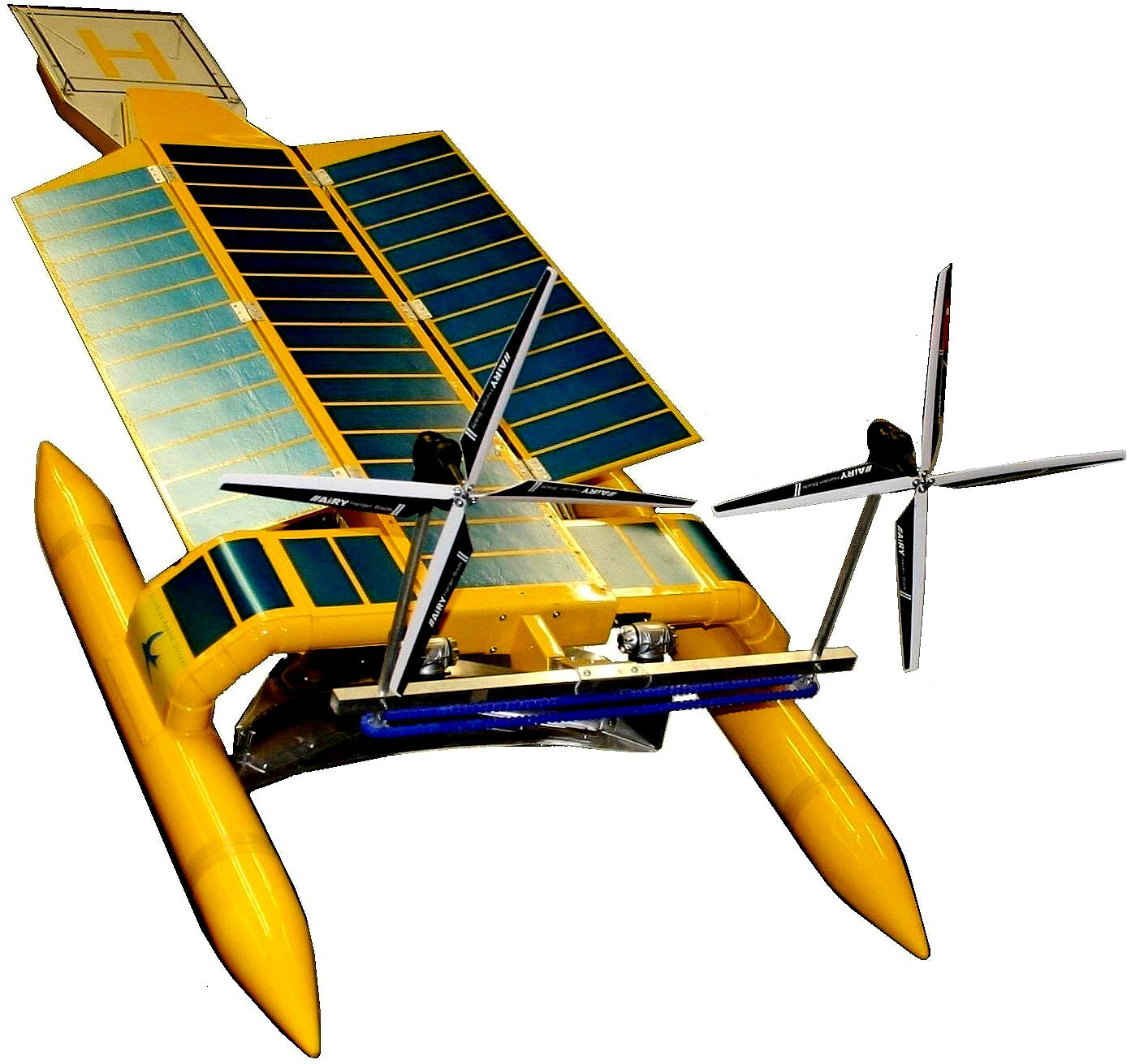
SeaVax (above)
is still the only ocean going machine designed to harvest ghost
fishing nets. Face facts, a vessel like this is not going to be built by
risk averse corporations or academics. Policy makers need to recognise
this. If funds had been forthcoming in 2020, a 17 meter (1/3rd) size
prototype would now be scouring the seas - as a demonstrator -fully
autonomously, with drone manual override.
Development
funds need to be made available to Maverick marine engineers, who are
willing to accept one of the biggest challenges of our time. The SeaVax
trademark
is available as a free license to anyone brave enough to pick up this
gauntlet. Steerage can be provided. All
enquiries to Cleaner
Ocean Foundation.
Plastic production soared from 2 million tonnes in 1950 to 348 million tonnes in 2017, becoming a global industry valued at US$522.6 billion, and it is expected to double in capacity by 2040. The impacts of
plastic production and pollution on the triple planetary crisis of
climate
change, nature loss and pollution are a catastrophe in the making:
-
Exposure to plastics can harm human
health, potentially affecting fertility, hormonal, metabolic and neurological activity, and open burning of plastics contributes to air pollution.
-
By 2050 greenhouse gas emissions associated with plastic production, use and disposal would account for 15 per cent of allowed emissions, under the goal of limiting
global warming to 1.5°C (34.7°F).
-
More than 800 marine and coastal species are affected by this pollution through ingestion, entanglement, and other dangers.
Some 11 million tonnes of plastic waste flow annually into oceans. This may triple by 2040.
-
A shift to a circular economy can reduce the volume of plastics entering
oceans by over 80 per cent by 2040; reduce virgin plastic production by 55 per cent; save governments US$70 billion by 2040; reduce
greenhouse gas emissions by 25 per cent; and create 700,000 additional jobs – mainly in the global
south
'UNEP'
is the United Nations
Environment Programme. Their mission is to provide leadership and encourage partnership in caring for the environment by inspiring, informing, and enabling nations and peoples to improve their quality of life without compromising that of future generations.
In our view leadership equals actions. Doing not talking about doing.
The difference between having an idea, and doing it - is doing it.
Anyone can talk about doing things and encourage other people to take
risks and think creatively, but few step into the arena and act on their
ideas - putting their time and money where their mouths are.